Fun for the whole family; no mathematical background needed.
With sponsorship by a grant from the Simons Foundation, Professors Jaclyn Lang and Beca Lufi have led a team of 21 undergraduates, graduate students, and other faculty of the Math Department in creating an exhibit that will be on display at the Math Festival at the International Congress for Mathematicians (ICM), July 24–25, 2026 at the Pennsylvania Convention Center in Philadelphia.
The exhibit, titled Are we there yet? An exploration of distance, uses the concept of distance along with hands-on activities to showcase the process of mathematical development and exploration. Activities include a hyperbolic virtual reality video game, p-adic cornhole, tessellation puzzles, origami, straightedge and compass constructions and more.
The Math Festival is free and open to the public with registration, More information can be found on the department’s Outreach webpage. We spoke with Professor Lang for more details on the exhibit.
How did the idea for Are We There Yet? An Exploration of Distance originate?
I gave a talk by the same title at the Program in Mathematics for Young Scientists (PROMYS) in Bangalore, India in 2024. The program is for talented high school students to explore mathematics. I only got through a small fraction of the material I intended to cover, because the students were full of excellent questions. It made me think that an interactive exhibit, where people can learn at their own pace, might be a good way to convey many of the lessons I incorporated into that talk.
Why did you choose "distance" as the central theme?
People have preconceived, often negative, notions of what mathematics looks like. They usually imagine a lot of abstract and unmotivated calculations. We wanted to convey something more representative of what it is like for mathematicians to do math. We experience curiosity, exploration, surprising examples, confusion and the art of asking good questions. Distance is a great concept to capture these elements because it is both something that everyone is familiar with and very visual. We can illustrate our ideas with pictures rather than with formulae and calculations. People have an intuition for how distance behaves, and we can surprise that intuition when we change the definition of distance and see new phenomena.
How have undergraduate and graduate students contributed to the project?
The 17 undergraduate and graduate students have done a huge amount of work on the exhibit. There were five groups corresponding to the five different types of distance that the exhibit explores. Each team was led by one or more graduate students. They created a poster to summarize the key properties of their notion of distance, and they created many of the activities related to that theme. Some created web apps, others crocheted hyperbolic planes and others created a model of the streets of Philadelphia. They shared their posters at the final meeting of the Math Club this past semester. Moreover, many of these students will help out with the activities at the Math Festival itself.
What skills have students gained through designing and building the exhibit?
Many of the undergraduate students learned new mathematics. Even a typical math major need not encounter ideas like hyperbolic geometry or p-adic numbers during their undergraduate degree, so our participants had to learn math beyond their usual classes. The graduate students learned leadership and mentorship skills by guiding their group toward producing a final product, and everyone learned teamwork. All of the students honed their technical communication skills in a number of ways, from creating the posters, presenting them in Math Club, and preparing to guide the general public in the activities at the Math Festival.
What are your favorite parts of the exhibit?
The first is an image. There are four circles — two (solid) blue and two (dotted) orange. All four of the circles have radius 1, and their center is the marked point inside the circle! For the two orange circles this is not surprising; they look the way we expect circles to look because they are made with the usual (Euclidean) definition of distance. The two blue circles are made with “hyperbolic” distance. In this distance, the horizontal axis is infinitely far away, which makes the circles look different depending on where their center is located, even though the “hyperbolic radius” isn’t changing.
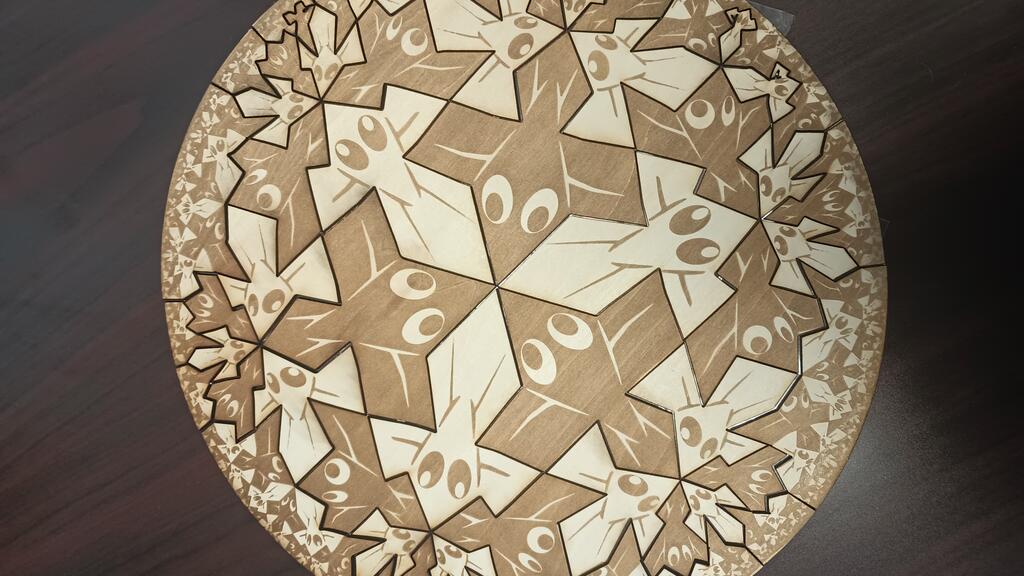
The second is a puzzle that demonstrates the unintuitive way that area works in hyperbolic geometry; each piece has the same hyperbolic area (even though their “usual” areas are very different). It was etched and cut in Temple’s Makerspace in Charles Library.
If a visitor spends only five minutes at your exhibit, what's the one thing you hope they walk away understanding about mathematics?
Mathematical thinking is accessible to everyone, and you can reach surprising places from a simple and familiar starting point.