
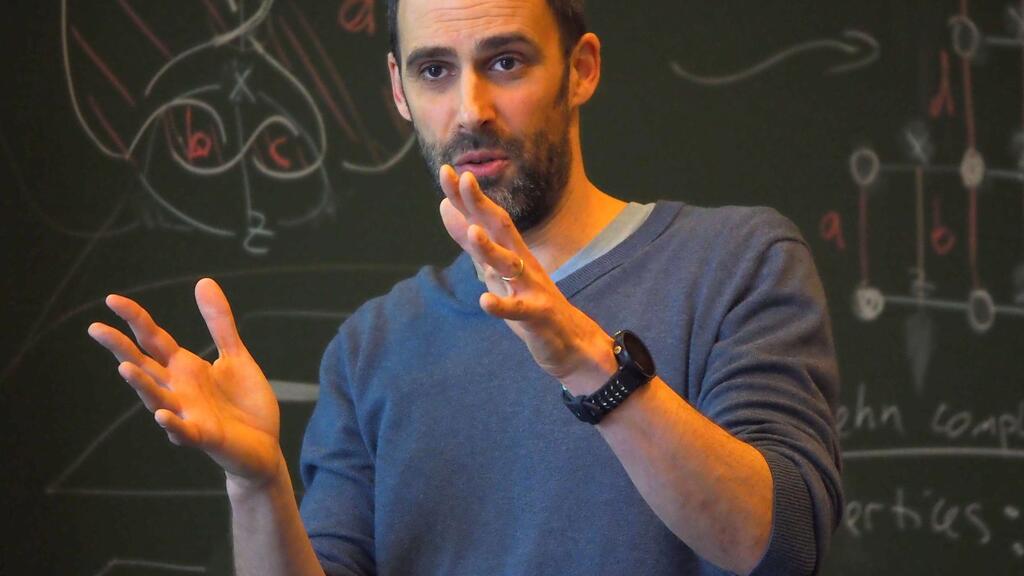
Temple Mathematics Professor Dave Futer has been named to the 2027 class of Fellows of the American Mathematical Society.
Recognized by their peers, AMS Fellows have made outstanding contributions to the creation, exposition, advancement, communication, and utilization of mathematics. More information about the program and this year's winners can be found on the website of the AMS.
Below are Professor Futer's thoughts on the honor
What does being elected a Fellow of the American Mathematical Society mean to you personally and professionally?
It’s a big honor to be recognized in this way. I have been writing some papers that had an impact on my field (low-dimensional geometry and topology), and I’ve also had a big role in leading one of the American Mathematical Society journals. So it feels very significant to be recognized by my peers in the profession.
Was there a particular project or collaboration or 'breakthrough' that you consider especially meaningful in your career?
I’ve had very long-running collaborations with Effie Kalfagianni, Jessica Purcell and Saul Schleimer. Together, we built a pretty detailed theory of how the geometry of various 3-dimensional spaces (that is, various potential models for our physical universe) changes when you perform a surgery on the space. Those collaborators have also become lifelong friends.
How can universities help cultivate mathematical talent?
We need to challenge our students to think deeply and grapple with difficult concepts. Running problem-solving courses and undergraduate research projects is a great way to do this. In an age when more and more work will be automated, I firmly believe that teaching quantitative reasoning and deep thinking is the best way to prepare students to be competitive.
How does this recognition reflect the strength of Temple's mathematics program?
We are a small department that currently has 17 tenure-track faculty. Of that number, four current faculty and two recent retirees are all AMS Fellows. So I believe this recognition shows the department punches far above its weight.
One of the responsibilities of Fellows is to present a “public face” of excellence in mathematics. What should mathematicians do to help more people understand the profession and the power of math to help address many of today's complex challenges?
Mathematicians need to keep making the argument that theoretical research is incredibly useful, even if we do not immediately see the payoff. Medical imaging, cybersecurity and GPS would not work without some incredibly deep mathematics that was developed for a different reason, and only later found those applications. Investing in research is like planting seeds for a future harvest, except the lead time is longer.
On a related note, we need to do a better job of investing in the next generation. There is a commonly held belief that mathematical skill and problem-solving ability is almost like a magical power that some possess while others do not. Instead, acquiring that skill is much closer to getting good at a sport or an instrument: it comes with thousands of hours of practice. The joy of discovery as the payoff of the long practice is something else that the profession should do a better job of communicating.