
Hosted by the College of Science and Technology, the 2026 Research and Leadership Symposium highlighted undergraduate student research and discovery at Temple.
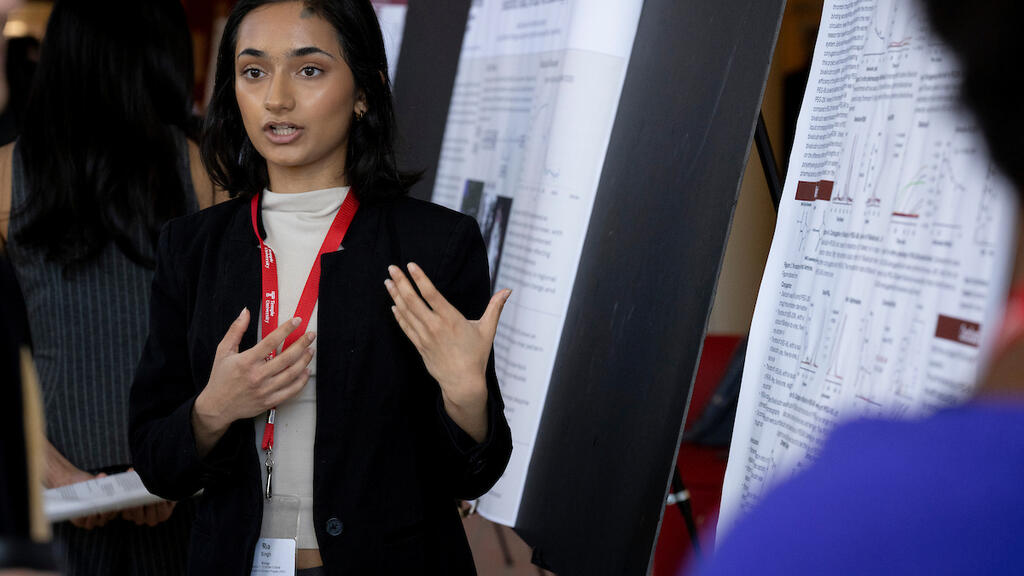
The Research and Leadership Symposium provides an opportunity for students to present authentic research early in their academic career.
Photo by Dan Z. Johnson
From deep-sea discoveries to public health solutions to cancer cell investigations, the 2026 Research and Leadership Symposium celebrated the diversity of undergraduate student research at Temple’s College of Science and Technology.
The lobby of the Science Education and Research Center buzzed with activity throughout this full-day event as 120 students presented their work during one of four poster sessions. Each student developed their research under the guidance of a faculty mentor, gaining hands-on experience in real lab environments across the university, including the Aging + Cardiovascular Discovery Center, Center for Substance Abuse Research, Fox Chase Cancer Center, Temple Ambler Field Station and more.
Research topics spanned a range of disciplines — from neuroscience and cognitive modeling to DNA repair in melanoma cells; from Alzheimer’s treatment to developing non-habit-forming opioids for pain treatment; from pandemic response preparedness to a glacial retreat in Alaska to the properties of stellar clusters. The symposium also featured the work of students in the STEM Leadership Fellows program, an experiential learning program in which current students serve as mentors, tutors and classroom support to improve peer student success.
“We create opportunities for students to gain early and authentic research experience in their academic careers and connect to supportive mentors, which improves student retention. They get to see the relevance of what they’re learning in class in an actual project,” said Sue Jansen Varnum, senior associate dean of Undergraduate Affairs and Science Education. “I think one of the most important things you can do as an R1 university is to create access to research opportunities and pathways for students to succeed.”
Varnum emphasized that early access can also connect students with career opportunities and networks after graduation.
Temple senior Nina Pelletier says that mentorship from a faculty member has been foundational to her academic experience. In the lab of Erik Cordes, professor and chair of the Department of Biology and recently named AAAS fellow, Pelletier worked closely with April Stabbins, assistant professor of research in the Department of Biology, to study previously unidentified deep-sea marine species. Pelletier pursued research during all four of her undergraduate years at Temple, and she says that the opportunity has been essential to shaping her future career.
“Getting to do research since my sophomore year at Temple has been such an amazing undergraduate experience,” said Pelletier. “Through this project, I discovered my passion for this work, and now I am planning to pursue a master's degree in invertebrate biology after I graduate.”
For students like Pelletier, events like this provide the opportunity to not only showcase their research but practice how to present themselves and engage an audience.
“The next generation of STEM researchers are in this room,” said Adam Stefanile, director
of the Research Scholars Program. “It’s not enough to know the science; you also have to
know how to present yourself, how to dress, how to shake hands and maintain eye
contact. We coach the students on how to engage an audience. These skills set them up
for success not only at today’s symposium but in their future academic and professional
careers.”
For many, the College of Science and Technology’s Leadership and Research Symposium was the first time they had ever shared their work with a large audience, like current sophomore Shiza Moghal. She conducted research into the behavior of cancer cells in the Snyder Lab in the Aging + Cardiovascular Discovery Center at the Lewis Katz School of Medicine and says it was her first time in a hands-on research lab.
“I am interested in pursuing a career in medicine, so it’s great to be able to participate in research related to the human body this early on,” said Moghal. “It was a lot of work, but now that I am here, I am feeling confident. It’s nice to be around other people who are also sharing their work.”